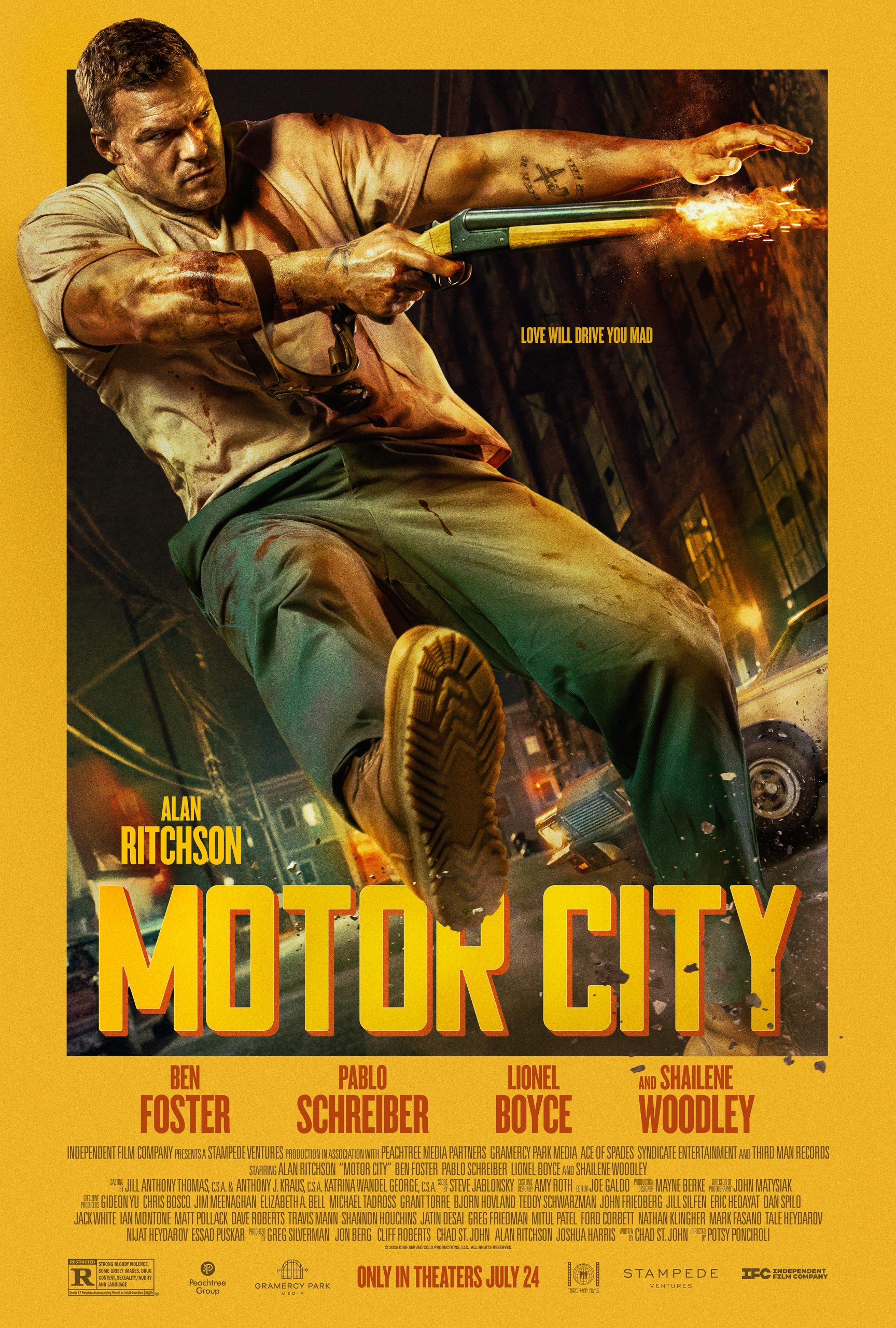
I got an early screening of Motor City, and I have to say, I walked away really impressed.
Before seeing it, I had watched the trailer and even did a trailer reaction. The cinematography immediately caught my attention, and I thought it looked like it was doing something a little different. I wasn’t wrong.
Set in the gritty backdrop of 1970s Detroit, Motor City follows John Miller (Alan Ritchson), a man who falls for the girlfriend of a powerful gangster. After being framed for a crime he didn’t commit and sent to prison, John spends years plotting his revenge. It’s a familiar revenge setup on paper, but the way this story is told makes it feel anything but ordinary.
Let me say this right away: you’re either going to love this movie or hate it.
I can already picture the reactions because this isn’t a film that’s trying to please everyone. I loved it.
The biggest thing people need to know going in is that there is no dialogue. None.
That sounds like a huge risk, and honestly, it is. But it works. The story unfolds entirely through performances, music, editing, and visual storytelling. Director Patti Ponciaroli puts complete trust in his cast to communicate every emotion with expressions, body language, and movement instead of words.
That isn’t easy to pull off.
Alan Ritchson delivers a restrained performance that relies almost entirely on physical acting, while Shailene Woodley and Ben Foster fit perfectly into this stylized world. Every look, every pause, and every interaction carries weight because there aren’t any conversations explaining what the characters are thinking.
I also have to imagine a huge portion of this film’s budget went toward music licensing because the soundtrack is packed with one incredible song after another. The music becomes part of the storytelling, filling the space where dialogue normally would.
Visually, this movie is stunning.
The opening five minutes immediately pulled me in. From that point on, I was hooked by the cinematography, the camera angles, and the use of slow motion. Normally, excessive slow motion can wear on me, but here it felt intentional. It matched the style of the film and helped create this dreamlike, almost operatic feeling.
The production design deserves a lot of credit, too.
The 1970s Detroit setting gives the movie its identity. I actually found myself wondering whether this concept would have worked if it had been set in present day. I don’t think it would have had the same impact. The time period, the grit of the city, the cars, the locations, and especially the costumes all work together to create something that feels completely immersive.
Speaking of costumes, Sophia’s wardrobe was incredible. Every outfit Shailene Woodley wears looked amazing, and I wanted all of them.
The movie isn’t perfect. There are definitely some familiar revenge movie tropes throughout the story. My sister actually pointed out that those recognizable beats almost have to exist because there’s no dialogue to provide additional character development. The visuals have to carry everything, so keeping parts of the narrative familiar helps the audience stay connected.
Then there’s the elevator fight.
I’m not going to spoil anything, but it’s one of the best-shot action sequences in the entire movie. The choreography, camera work, and pacing all come together beautifully. It’s the kind of scene that sticks with you after the credits roll.
At the end of the day, Motor City won’t be for everyone. It’s experimental. It’s stylish. It takes a big swing by removing dialogue completely, and that choice alone is going to divide audiences.
For me, though, it absolutely worked.
I was engaged from beginning to end, and the one-hour-and-forty-three-minute runtime flew by. It’s rare to see a movie commit this fully to its artistic vision, and whether you end up loving it or not, I think it’s worth experiencing.
Rating: 4.5 out of 5 stars.